
Onion Deep Processing & Key Processing Equipment
Why is it important to focus on the deep processing of onions?
Onions are one of the most widely used seasoning and ingredient crops in the world. After harvesting, they can be stored for a long time and enter various downstream processing stages (cold chain distribution, slicing, pickling, peeling, dicing and heat processing).
With rising standards and automation requirements in the food industry, onion processing is no longer simply about manual peeling and cutting. Instead, it requires large-scale production through high-capacity, low-loss, and hygienic equipment chains to reduce labor costs, improve yield rates, and enhance food safety.
Onion Cultivation & Nutritional Value
Onions are highly adaptable and mainly produced in temperate and subtropical regions. Their nutritional value lies in their rich content of sulfides (which give them their characteristic pungent flavor), polyphenols, vitamin C, and dietary fiber, providing antioxidant and digestive benefits.
For processing enterprises, origin, variety, and post-harvest processing directly affect processing yield and shelf life—smooth skin, uniform size, and moderate moisture content (too wet affects peeling efficiency, too dry affects breakage rate) are the basic conditions for efficient deep processing.
Market size and business opportunities
The European, North American, and Middle Eastern food processing and ready-to-eat meal markets have driven demand for onion processing. For food processing companies, the core opportunity lies in:
Pre-cut sliced/frozen semi-finished products (large-volume purchases by restaurant chains and processed food plants)
Vacuum-sealed or pickled products (extended shelf life, export demand)
Entering the high-end catering market by differentiating products by their place of origin (organic/special varieties)
Equipment and automation can translate daily output, labor costs, and unit yield into competitiveness, making them suitable for buyers seeking large-scale and stable suppliers.
Common Onion Deep Processing Equipment and Functional Analysis
Key equipment on a complete processing line includes: incoming sorting, top and tail removal, peeling (gas or blade wheel), sorting and conveying, cutting (slicing/dicing), washing and dehydration, and packaging.
Different equipment has different focuses: speed, yield, capacity, hygiene, and compatibility with different onion diameters.
Automated peeling machine (core equipment)
Function and principle: First, orient and remove the top and bottom, then peel off the skin using a cutting/air blower or a blade wheel.
Workers place onions on a conveyor belt, and an onion cutting machine can perform this function simultaneously, maximizing productivity. The capacity can reach 500KG per hour or 1000KG per hour, making it suitable for large-scale industrial production.
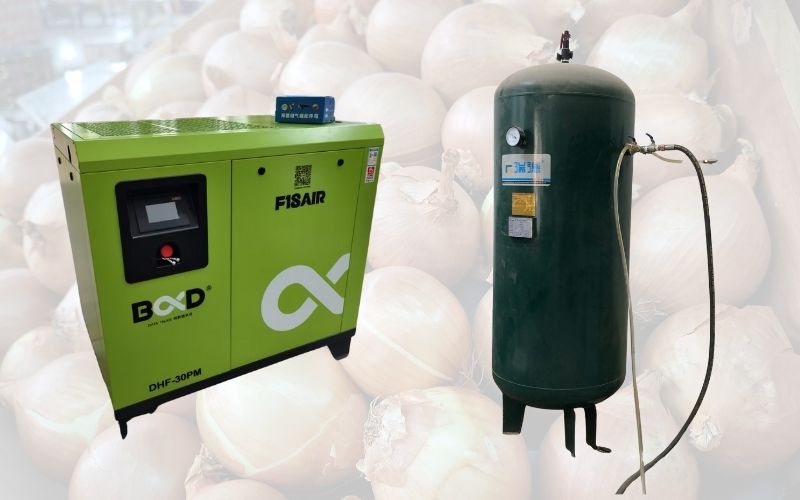
Currently, many factories in China use air-blowing to remove onion skins. This method, employing industrial screw air compressors and air tanks, achieves a more perfect peeling effect without damaging the onion's outer skin.
Grading, sorting and visual inspection equipment.
High-end models are equipped with vision cameras for automatic positioning and defective product rejection, which can reduce human inspection and improve the consistency of subsequent cutting.
For onions entering the slicing/freezing process, uniform diameter and orientation are beneficial for cutting accuracy and speed.
Slicer and Dicer
Choose between a ring slicer or a multi-blade dicing machine based on production line requirements. Key parameters include: adjustable slice thickness range, blade material, rotation speed, feed method, and adaptability to semi-frozen meats or soft vegetables. For onion slicing, blade corrosion resistance and ease of cleaning (no residue buildup) are primary considerations for food companies.
Cleaning, dehydration and packaging equipment
After peeling, the products need to be properly washed and dehydrated (using airflow or centrifugation). Packaging options include metered bagging, weighing and boxing, or vacuum/modified atmosphere packaging (extended shelf space). The entire production line must consider HACCP, IP ratings, and ease of cleaning.
Processing Parameters and Key Points of Process Control
Product grading: It is recommended to first use a vibrating screen or visual grading to standardize the 45–105 mm or factory target diameter range, thereby improving peeling efficiency.
Peeling methods: Dry peeling has the advantage of no wastewater treatment, making it suitable for food-grade high cleanliness requirements; air pressure peeling performs well in terms of shape preservation and non-destructive treatment; visual core removal can maximize yield and shape retention.
Capacity matching: If the goal is to continuously supply large customers (chain stores/food factories), the selected equipment should ensure that the peeling capacity is ≥ 1.2 times the subsequent slicing/packaging capacity to avoid production line bottlenecks.
Hygiene and Disassembly: All contact surfaces should be SS304 (or higher), and the structure should facilitate CIP (if required) and bare-hand disassembly to minimize cleaning downtime.
Energy consumption and air supply: Air strippers require a stable supply of compressed air. When selecting a model, confirm the energy ratio and the site's supply capacity.
Equipment Selection Recommendations (a brief list for procurement)
Production target: Define daily/hourly output (e.g., 3,000–10,000 pieces per hour or per kg), then select the appropriate machine model (suitable for output per kg/h).
Product diameter range: Onions come in various diameters. Small onions require custom-made equipment. Medium-sized onions also have specialized models available.
Hygiene and Certification: Choose models with CE certification, easy disassembly and cleaning, and a design without blind spots. Prioritize maintenance, tooling, and spare parts support provided by the manufacturer.
Business strategy and return on investment considerations
Scale saves labor costs: Highly automated production lines can transform the labor-intensive peeling process into a process that can be monitored by 1-3 people, saving manpower in the long run and reducing the risk of quality fluctuations;
Production line flexibility: Modular models (compatible with sorting, slicing, and packaging modules) should be prioritized to facilitate future capacity expansion or product category diversification.
Total Cost of Ownership (TCO): In addition to the equipment price, the costs of installation and commissioning, gas/electricity upgrades, spare parts, and tool replacement and cleaning should be included. High-capacity, low-loss models are often more cost-effective in the long run.