
Commercial Vegetable Cutting and Washing Equipment for Restaurant Kitchens
Modern restaurant kitchens require high efficiency, stable performance, and consistent food quality. Whether it is a small restaurant, a chain brand, or a central kitchen, vegetable preparation takes up a large proportion of daily kitchen operations. Manual cutting and washing not only increase labor costs but also lead to inconsistent cutting sizes and hygiene risks.
1. Why Restaurants Need Commercial Vegetable Processing Equipment
In restaurant back kitchens, vegetables must be:
Cleaned efficiently
Cut uniformly
Processed quickly during peak hours
Prepared according to specific dish standards
Common problems in manual vegetable preparation include:
Inconsistent slice thickness
Uneven vegetable cubes
Low efficiency during busy hours
High labor dependency
Food safety risks caused by insufficient washing
Commercial vegetable cutting machines and vegetable washing machines help restaurants standardize preparation, improve efficiency, and reduce labor costs.
2. Commercial Vegetable Cutting Machines for Restaurant Kitchens
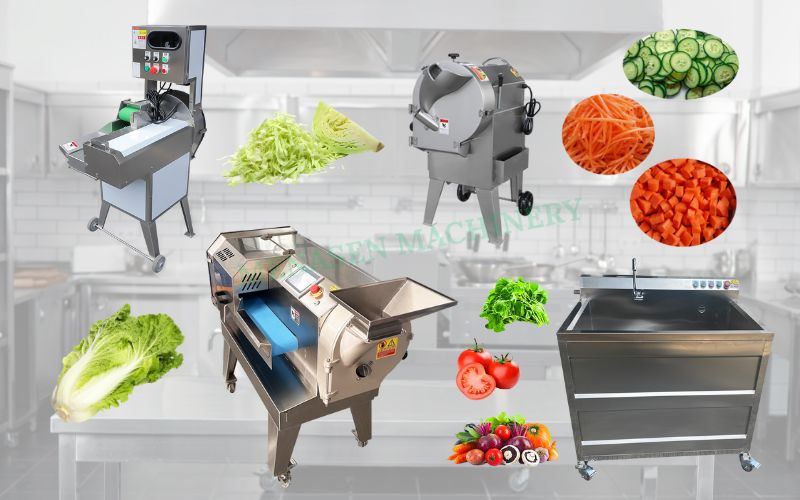
Vegetable cutting machines for restaurant use can be broadly divided into root vegetable cutting machines, leafy vegetable cutting machines, and multi-function vegetable cutting machines.
3. Root Vegetable Cutting Machines for Restaurants
Suitable Vegetables
Root vegetable cutting machines are mainly used for:
Potatoes
Carrots
Onions
White radish
Sweet potatoes
These vegetables are commonly used in fries, stir-fried dishes, soups, and side dishes.
Cutting Functions and Sizes
Vegetable Dicing
Common cube sizes in restaurants:
10 mm
15 mm
Used for:
Potato cubes
Carrot cubes
Onion cubes
Uniform vegetable dicing ensures even cooking and better dish presentation.
Vegetable Slicing
Common vegetable slice thickness:
2–3 mm (most common for restaurant use)
Suitable for:
Potato slices
Carrot slices
Onion slices
Thin and consistent slices are essential for frying and quick cooking.
Vegetable Shredding
Common shredded vegetable size:
2–3 mm (especially for potato shreds)
Used for:
Potato shreds
Carrot shreds
Commercial vegetable shredding machines produce uniform strips that are difficult to achieve manually
4. Leafy Vegetable Cutting Machines for Restaurant Kitchens
Suitable Vegetables
Leafy vegetable cutting machines are designed for:
Celery
Lettuce
Cabbage
Chinese cabbage
Chives
Leeks
Leaf vegetables require a different cutting structure compared to root vegetables, focusing on clean cuts without crushing.
Adjustable Cutting Length
Most leafy vegetable cutting machines offer adjustable cutting lengths from 1 mm to 60 mm, allowing restaurants to meet different menu requirements.
Common cutting lengths:
50 mm: Used in Korean cuisine for kimchi preparation
6 mm: Used for finely cut leafy vegetables
20–30 mm: Common for stir-fried leafy vegetables
Korean Restaurant Application: Kimchi Preparation
In Korean restaurants, cabbage is the primary raw material for kimchi. A leafy vegetable cutting machine is the ideal solution for this application.
Recommended settings:
Vegetable type: Chinese cabbage
Cutting length:
50 mm for traditional kimchi
6 mm for finely cut variations
Using a dedicated leafy vegetable cutting machine ensures uniform cuts and improves fermentation consistency.
5. Multi-Function Vegetable Cutting Machines for Restaurants
For restaurants that process both root and leafy vegetables, a multi-function vegetable cutting machine is the most practical solution.
Functions
A multi-function vegetable cutting machine can:
Dice root vegetables
Slice root vegetables
Shred root vegetables
Cut leafy vegetables into segments
Adjustable Cutting Range
Cutting size adjustable from 1 mm to 60 mm
One machine meets multiple menu requirements
Typical Restaurant Use Cases
Potato shredding at 2–3 mm
Vegetable slicing at 2–3 mm
Vegetable dicing at 10 mm or 15 mm
Leafy vegetable cutting at 20–50 mm
This flexibility makes the multi-function vegetable cutting machine ideal for restaurants with diverse menus.
6. Commercial Vegetable Washing Machines for Restaurant Kitchens
Cutting efficiency must be matched with proper washing. Commercial vegetable washing machines are essential for maintaining food hygiene in restaurant kitchens.
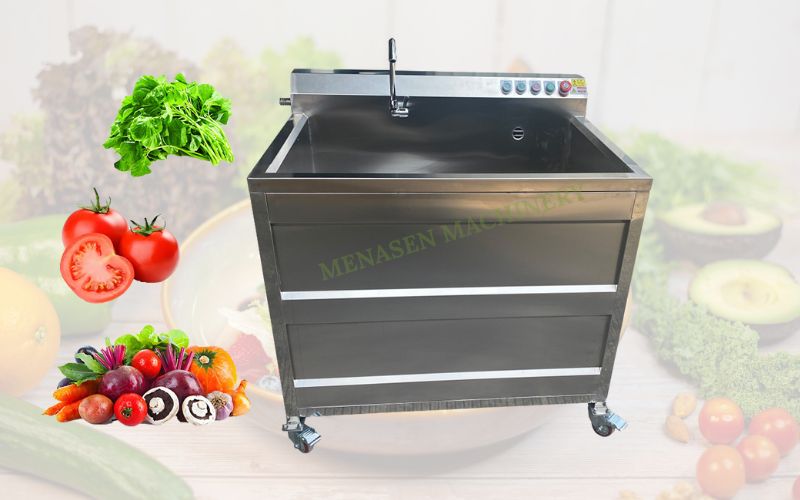
Single Tank Vegetable Washing Machine with Ozone
A single tank vegetable washing machine with ozone is especially suitable for restaurant back kitchens due to its compact design and ease of operation.
Functions and Advantages
Washing leafy vegetables and root vegetables
Cleaning fruits and vegetables
Ozone sterilization to reduce bacteria and odors
Food-grade stainless steel construction
Easy water filling and drainage
Suitable Vegetables
Lettuce
Spinach
Cabbage
Potatoes
Carrots
Onions
Apples
Other fruits and vegetables
Ozone Washing for Food Safety
Ozone vegetable washing helps improve hygiene standards by reducing surface contaminants. It is widely used in commercial kitchens and catering environments that require higher food safety levels.
7. Recommended Equipment Combination for Restaurant Back Kitchens
A practical and efficient restaurant kitchen setup usually includes:
Option 1: Standard Restaurant
Multi-function vegetable cutting machine
Single tank vegetable washing machine with ozone
Option 2: High-Volume Restaurant or Chain Store
Dedicated root vegetable cutting machine
Leafy vegetable cutting machine
Commercial vegetable washing machine with ozone
Option 3: Korean Restaurant or Specialized Cuisine
Leafy vegetable cutting machine (for cabbage and kimchi)
Vegetable washing machine with ozone
8. Why Stainless Steel Matters in Restaurant Equipment
All commercial vegetable cutting and washing machines used in restaurant kitchens should be made of food-grade stainless steel.
Benefits include:
Easy cleaning
Corrosion resistance
Compliance with food safety standards
Long service life
9. Final Thoughts
Efficient vegetable processing is a core part of restaurant kitchen operations. Choosing the right vegetable cutting machine and vegetable washing machine helps restaurants standardize food preparation, improve efficiency, and meet hygiene requirements.
Whether cutting potatoes into 2–3 mm shreds, slicing vegetables into uniform pieces, dicing vegetables into 10 mm cubes, or preparing cabbage for kimchi, commercial vegetable processing equipment provides reliable solutions for restaurant back kitchens.