
Advantage of Industrial Meat Mincer
In many large meat processing plants, meat grinders are an essential piece of equipment. Because meat grinders are one of the important equipment for making sausages.
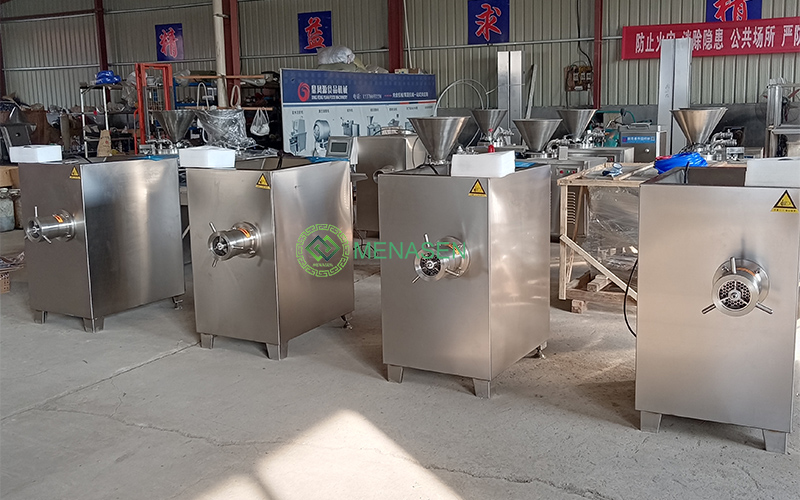
Section 1: Features of industrial meat grinder
1. Efficient production capacity
High output: Industrial meat grinders are designed for continuous operation and can process hundreds of kilograms to several tons of meat per hour, much higher than domestic or small commercial models.
High degree of automation: some models are equipped with automatic feeding and discharging systems to reduce manual intervention and improve efficiency.
2. Powerful power system
High-power motor: usually uses a motor of 1.5kW or more (or even higher) to ensure stable operation when processing hard ingredients (such as frozen meat and meat with tendons).
Durable transmission structure: The gear or belt transmission system is reinforced and suitable for long-term high-intensity work.
3. Versatility and adaptability
Multi-specification perforated plates (screens): Perforated plates with different apertures (such as φ3mm, φ5mm, φ8mm, etc.) can be replaced to produce minced meat of different coarseness and fineness to meet the needs of sausages, meat fillings, meat sauce and other products.
Broad-spectrum raw material processing: In addition to meat, it can also process vegetables, fish, seasonings, etc. (machine configuration needs to be adjusted).
4. Hygiene and safety design
Food grade material: Most of the contact parts are made of stainless steel (such as 304/316), which meets food safety standards, is corrosion-resistant and easy to clean.
Protective measures: Equipped with emergency stop button, protective cover, anti-blocking design, etc., in compliance with industrial safety regulations (such as CE, HACCP).
5. Structural stability and durability.
Heavy-duty body: cast iron or reinforced stainless steel frame to reduce vibration and extend service life.
Removable knife set: The knife and spiral propeller are made of high-hardness alloy steel and can be removed for grinding or replacement.
6. Specialization Segment Type
Frozen meat grinder: specially designed for processing frozen meat below -18℃, equipped with a powerful ice-breaking blade.
Bone and meat separator: integrated deboning function, suitable for poultry processing.
Vacuum meat grinder: reduces oxidation during the mincing process and keeps the meat fresh and tender.
7. Easy to maintain
Modular design: key components (such as cutter head and orifice plate) can be quickly disassembled and assembled for easy cleaning and maintenance.
Self-cleaning function: some high-end models support high-pressure water gun flushing or CIP (cleaning in place) system.
8. Energy and Environmental Protection
Low energy consumption design: high-efficiency motors and optimized transmission structure reduce energy consumption per unit output.
Waste control: less minced meat residue during mincing, reducing waste.
Typical application scenarios
Large food factories: production of ham, sausage, quick-frozen dumpling fillings, etc.
Central kitchen: processing standardized meat fillings for chain restaurants.
Fresh food supermarket: fresh meat minced on site for customers to choose from.
Selection suggestions
The machine model needs to be matched based on production requirements (such as 500kg or 5 tons per hour), raw material characteristics (fresh meat/frozen meat), finished product fineness and other factors, and priority should be given to products that meet local food safety certifications.
Section 2: Industrial meat grinder output
Classification of production levels
Small industrial meat grinder
Output range: 50~300 kg/h
Power: 1.5-3 kW
Applicable scenarios: small and medium-sized catering central kitchens, butcher shops, small food processing plants.
Example: Processing pork filling (φ5mm perforated plate) about 200 kg/h.
Medium Industrial Meat Grinder
Output range: 300~800 kg/h
Power: 3-7.5 kW
Applicable scenarios: medium-sized meat processing factories, quick-frozen food filling processing.
Example: Continuous minced beef (with tendons) approx. 500 kg/h.
Large industrial meat grinder
Output range: 800~3000 kg/h
Power: 7.5-15 kW
Applicable scenarios: large slaughterhouses, sausage/ham production lines.
Example: Processing of frozen chicken (-10℃) about 1.5 tons/h
Extra large professional model
Output range: 3-10 tons/h
Power: 15-30 kW
Applicable scenarios: Industrial meat processing lines (such as luncheon meat and pet food production)
Section 3: Key factors affecting production
Raw material characteristics
Meat hardness: The yield of frozen meat (-18℃) is 30% to 50% lower than that of fresh meat, so a special frozen meat grinder is required.
Gluten/fat ratio: High-gluten beef is more difficult to grind than pure lean meat, which may reduce the yield by 20% to 40%
Orifice plate (screen) aperture
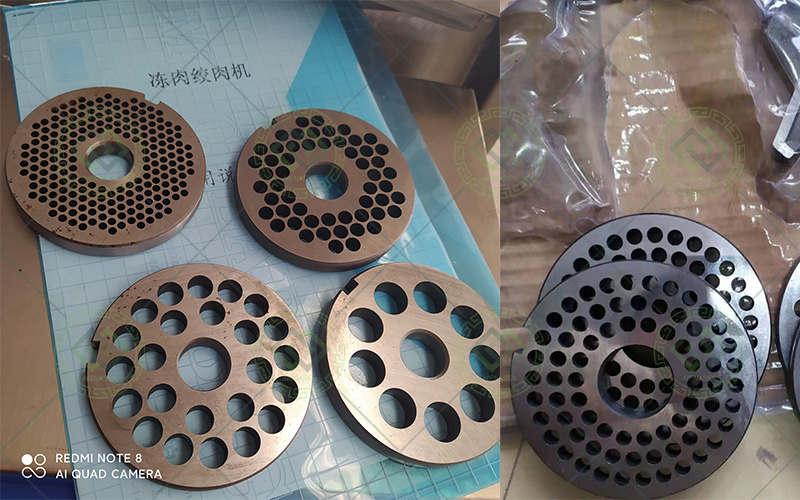
The smaller the aperture (such as φ3mm), the greater the resistance and the lower the yield.
Example: For the same machine model, the output of φ8mm orifice plate is about 50% higher than that of φ3mm orifice plate.
Device Configuration
Auger speed: High speed models (such as 200-400 rpm) are suitable for soft meat, but may affect the temperature of the minced meat.
Tool sharpness: Blunt knives will lead to reduced efficiency and require regular maintenance.
Degree of automation.
Models equipped with automatic feeding systems (such as conveyor belts) can improve the efficiency of continuous operations and reduce pauses caused by manual intervention.
Section 4: Production reference for typical application scenarios
Raw material type Orifice plate aperture Output (kg/h) Applicable machine power
Fresh pork (boneless) φ5mm 500~800 5.5 kW
Frozen mutton (-15℃) φ8mm 300~500 7.5 kW (for frozen meat only)
Chicken (with skin) φ3mm 200~400 3 kW
Beef (high gluten) φ10mm 600~1000 11 kW
Section 5: How to choose a meat grinder with suitable output ?
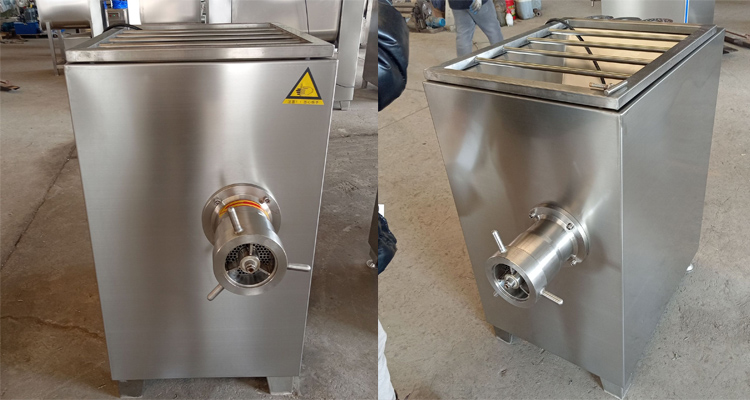
Calculation requirements: Based on the daily average/peak meat filling usage, reserve 20% capacity redundancy.
For example, if 1 ton of minced meat is needed every day and the working time is 8 hours, a machine with a capacity of at least 150 kg/h should be selected.
Consider scalability: If production may increase in the future, choose a model that can be upgraded (such as variable frequency speed regulation)
Verify actual test: Suppliers often provide trial machine services and recommend using your own raw materials to measure the output.
Section 6: Precautions
Avoid overloading: Continuously exceeding the rated output will shorten the life of the motor
Temperature rise control: High-yield machines need to be equipped with a cooling system (such as a water-cooled screw shaft) to prevent the meat temperature from being too high and affecting quality.
The output of industrial meat grinders requires a comprehensive evaluation of raw materials, processes and equipment performance. Professional manufacturers will provide detailed technical parameters to support selection.